

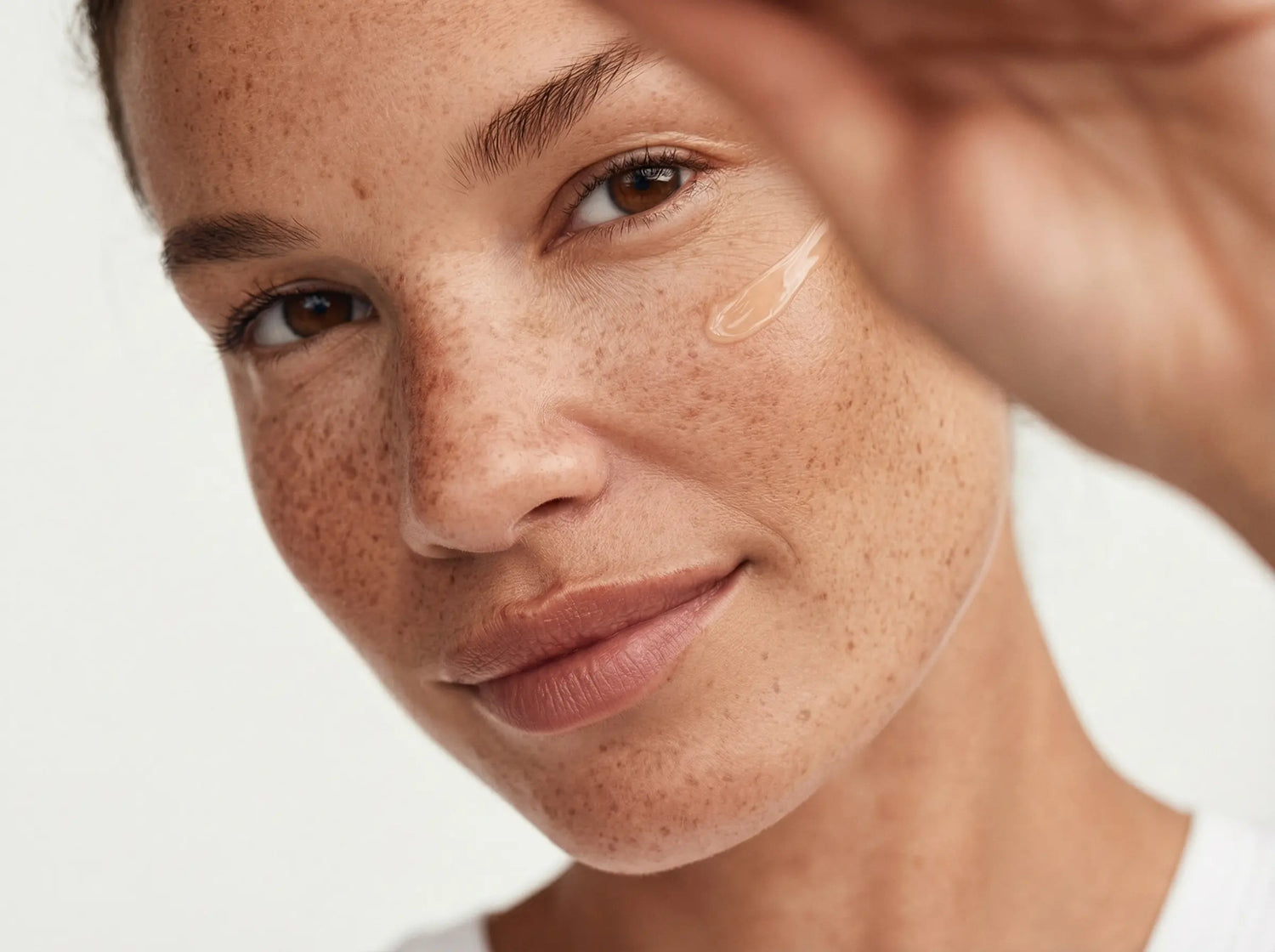
Does PDRN Actually Absorb Into Your Skin? The "Brick Wall" Truth Every Skincare Lover Needs to Know
If you've been following the glass-skin trends coming out of Seoul lately, you've likely heard of PDRN. Often called "Salmon DNA," it's the darling of Korean aesthetic clinics, praised for its almost mystical ability to make skin look smoother, firmer, and more radiant.
But here is the million-dollar question that most skincare brands hope you don't ask: Is that expensive PDRN serum actually going anywhere? Or is it just sitting on top of your face like an uninvited guest, only to be washed down the drain at the end of the day? To understand if PDRN actually works, we have to talk about the "Brick Wall" problem - and why your delivery method is arguably more important than the ingredient itself.
1. The Skin's Job Is to Keep You Out
We like to think of our skin as a thirsty sponge, ready to soak up every drop of expensive serum we apply. In reality, your skin is a highly efficient security guard.
The outermost layer, the stratum corneum, is built like a brick wall. Your skin cells are the bricks, and a complex mix of lipids (fats) acts as the mortar. This barrier's entire job is to keep things out—bacteria, pollution, and yes, even your favorite skincare products.
Most people think a product has "absorbed" because the stickiness is gone. Usually, that just means the water in the serum has evaporated or the silicone has dried. It doesn't mean the PDRN - the heavy hitter - has actually reached the layers where it can do the real work.
2. The Science of PDRN: Why Size Matters
PDRN (Polydeoxyribonucleotide) is a fragment of DNA typically extracted from salmon sperm. While it sounds exotic, the reason scientists love it is that salmon DNA is surprisingly similar to human DNA. In the world of regenerative medicine, it has been used for decades to heal chronic wounds and diabetic ulcers.
However, PDRN faces a massive physical limitation in skincare: The 500 Dalton Rule.
In dermatology, it is widely accepted that molecules larger than 500 Daltons (a unit of molecular weight) have an incredibly difficult time passing through an intact skin barrier. PDRN fragments typically range from 50 to 1,500 kDa (kilodaltons). To put that in perspective, PDRN is like trying to push a basketball through a chain-link fence.
The Scientific Proof: A study published in Marine Drugs notes that while PDRN has incredible anti-inflammatory and regenerative properties, its molecular weight means it usually requires a specific delivery vehicle to move past the surface.
3. Why Most "Passive" Serums Eventually Plateau
Have you ever started a new routine, seen great results for two weeks, and then... nothing? Your skin just stays the same? This is the Absorption Plateau. Traditional serums rely on passive diffusion. You rub it on, and you hope gravity and chemistry do the rest. Some small-molecule ingredients, like Vitamin C or Hyaluronic Acid, can shimmy their way into the upper layers. But for a high-performance, large-molecule active like PDRN, passive diffusion is highly inefficient.
Without a delivery system, your PDRN serum is essentially a very expensive surface moisturizer. You'll get a temporary glow, but you aren't triggering the deep cellular "salvage pathways" that PDRN is famous for in clinical settings.
4. The "Salvage Pathway": How PDRN Actually Works
To understand why we want PDRN deep in the skin, we have to look at how it works once it gets there. PDRN doesn't just "hydrate"; it acts as a bio-stimulator.
A2A Receptor Activation: PDRN binds to adenosine A2A receptors in your cells. This is like flipping a "repair" switch that tells your skin to stop being inflamed and start building new tissue.
The Salvage Pathway: When your skin is tired, aged, or damaged, it struggles to create new DNA from scratch. PDRN provides the "pre-built" blocks (nucleosides) that your cells can "salvage" to repair themselves quickly.
Collagen Synthesis: Research in Molecular Medicine Reports shows that PDRN specifically boosts fibroblast activity—the "collagen factories" of your skin.
5. Micro-Infusion: Bypassing the Security Guard
This is where the science of Micro-Infusion (like the system we've perfected at SkinOS) changes the game.
Instead of waiting for the PDRN to find its own way in, micro-infusion creates temporary, microscopic "channels" in the skin's surface using ultra-fine, 0.5mm gold-plated touchpoints.
Think of it this way:
Traditional Serum: Like trying to water a plant by misting the leaves. Some gets through, but most evaporates.
Micro-Infusion: Like aerating the soil before you water. You're ensuring the nutrients reach the roots where they can actually make an impact.
By creating these tiny pathways, you are temporarily increasing the skin's permeability. A 2025 review in Aesthetic Cosmetology and Medicine highlights that when PDRN is combined with delivery methods like microneedling or infusion, it enters the dermis to initiate reparative pathways that topical creams simply cannot reach.
6. Topical vs. Injectable: Is There a Middle Ground?
Until recently, if you wanted real PDRN results, you had to go to a clinic for Rejuran or "Salmon DNA Injections." These are effective but come with significant downsides:
Cost: $500–$1,000 per session.
Pain: Multiple needle injections across the entire face.
Downtime: Small "bumps" or bruising that can last for days.
Micro-infusion serves as the "Goldilocks" middle ground. It is more effective than a basic serum because it physically bypasses the stratum corneum, but it is far more accessible and painless than clinical injections.
In fact, a study mentioned by XJ Beauty suggested that advanced topical delivery of PDRN could achieve up to 70-80% of the efficacy of injectables when used consistently, without the associated trauma or cost.
7. Is 0.5mm the "Sweet Spot" for Home Use?
There is a common misconception that "deeper is better." In clinical settings, doctors may go 1.5mm or deeper, but this requires numbing cream and carries a risk of scarring if done improperly.
For at-home PDRN delivery, 0.5mm is widely considered the scientific "sweet spot."
It's deep enough: 0.5mm reaches the junction between the epidermis and the dermis, which is exactly where your melanocytes (pigment cells) and the tops of your fibroblast (collagen) network live.
It's painless: At 0.5mm, the touchpoints are too short to hit major nerve endings, making the process feel like a light "prickle" rather than pain.
Safety: This depth allows for the creation of micro-channels without causing significant bleeding or requiring a week of recovery.
8. What Results Should You Actually Expect? (A Timeline)
Skincare is a marathon, not a sprint. Because PDRN works by supporting your skin's natural biological repair, you won't see a "new face" overnight. Here is the typical physiological timeline:
Day 1-3 (The Glow): Immediately after infusion, your skin is flooded with hyaluronic acid and PDRN. You'll notice an immediate "plumpness" and hydration.
Week 2-4 (The Texture Shift): As the A2A receptors start signaling for repair, users often report that their skin feels "smoother" to the touch. Pore appearance may begin to look more refined.
Week 8-12 (The Structural Change): This is where the collagen synthesis peaks. This is when you notice the visible improvement in fine lines, "crepey" skin under the eyes, and overall firmness.
9. The Role of Synergistic Actives
PDRN is a team player. While it is the "hero" ingredient, it works best when paired with other clinical-grade actives that support the skin's barrier and hydration. The SkinOS Ampoules are formulated with:
Hyaluronic Acid: To provide the immediate "water-plump" effect.
Niacinamide: To calm redness and support the lipid barrier.
Peptides: To act as messengers, further encouraging collagen production.
When these are "infused" rather than just "applied," their combined bioavailability increases exponentially.
10. The Verdict: Don't Just Apply - Infuse.
If you're going to invest in high-end ingredients like PDRN, don't let the "brick wall" of your skin waste your money.
The science is clear: PDRN is a powerhouse for skin regeneration, but its effectiveness is entirely dependent on its ability to reach the target cells. By moving from passive application to active micro-infusion, you aren't just putting product on your skin - you're putting it to work.
Are you ready to stop plateauing and start infusing?
Explore the SkinOS PDRN Micro-Infusion System and see how our 0.5mm gold-plated technology delivers professional-grade DNA fragments directly where your skin needs them most. Experience the difference between surface-level skincare and deep-level skin transformation.
References & Further Reading
Polydeoxyribonucleotide (PDRN): A Promising Drug for Skin Repair. MDPI - Marine Drugs
PDRN exerts opposing effects on ERK activity in human skin keratinocytes and fibroblasts. Molecular Medicine Reports
Microneedling: Advances and Widening Horizons. Journal of Cutaneous and Aesthetic Surgery
The Evolution of PDRN from Injectable to Topical. Aesthetic Cosmetology & Medicine (2025)

Leave a comment
This site is protected by hCaptcha and the hCaptcha Privacy Policy and Terms of Service apply.